Archive for February 26th, 2008

Terastation Drive Replacement

February 26th, 2008

Back in 2005, i bought a Buffalo Terastation 1TB NAS (Network Attached Storage). Basically its a backup device – a mini-computer box with 4 harddrives, each 250GB, or 1TB total. Last week one of the drives died after a power outage (we get a lot of outages on san jose ave), and today i fixed it. However, it wasn’t that easy – I spent over 3 hours on it – when it should have taken less than one. So i’m just gonna note a few things so the next guy might have it easier. Now here’s where i’m gonna geek out, so all non-geeks .. move along.

When i first setup the terastion, i did a RAID5 + RAID1 – that means i got a 750GB partition out of my 4 250GB drives. So if any one of the four drives dies, i don’t lose my data. I just pop in a new drive and rebuild. Easy. This worked great for 3 years, never had to replace a drive. Every now and then we’d lose power and when i powered on my terastation, it would take 1-2 days to check the disks before we were good to go.

Last week Terastation would not recover – it would boot up for a minute, do disk check, then turn off (power light was off). However, each of the four drive status lights would stay red, with disk 3 blinking red. After reading the manual, I decided to replace disk 3. I also read the wiki FAQ, so i knew i could replace with any same-size or bigger drive. I did this, spending almost 45 mins opening the terstation up, switching the drive, and putting it back together. Turned it on, and it stayed on. Yay!

So now all i had to do is connect to the web manager interface and “rebuild the raid array”. Once i logged in, it said Raid array 1 error – i clicked it, and I’d get to array 1, and it listed disk 1, 2, 3, 4 .. but the checkbox to disk 3 was greyed out. I spent a while looking through the web pages and decided something might be wrong with my new disk. I turned it off, took the thing apart (only took 15mins this time), pulled out my new disk, and basically connected it to my PC in a external USB drive box. It worked fine. Ugh. Was terastation broken? I tried the old drive, that terastation thought was dead. It also seemed OK by PC standards. Ugh.

After going back in forth and trying different things, it turned out that the new drive had to have the jumper in Cable Select to work. The older 3 western digital drives were not in Cable Select mode. Whatever.

Also, the LED lights on the front don’t always do exactly what the manual or FAQ says. Specifically, i loved this blog on replacing terastation drive, but at the what he says is different than what i saw. Once I clicked ‘Restructure RAID Array’ , the lights were all going nuts and within a minute it went to a page that said “Restructuring has completed successfully” “Checking RAID Array”. At this point my 8 drive lights are blinking red and green – the 3 old ones have solid red status, new one is not lit, and all 4 have blinking green activitiy. Power light is on, diag light is blinking green. On web interface, i clicked on Raid Array 1 and it says it is “Rearing (x.x % Complete)”. I waited a few mins and refreshed page .. percent complete is increasing. It’s working !!! 4 hours later it finished – my setup is as good as it ever was.
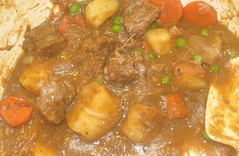
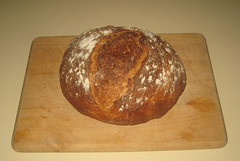
Dutch Oven Meal – Beef Stew and Homemade Bread

February 26th, 2008

I’ve already mentioned I love cooking, and I finally got a Dutch Oven. A heavy, cast-iron pot that provides even heating on the stove or in the oven. Cooks Illustrated recommended Tramontina 6.5 quart as their best buy – and i found it for $60 at target (labeled chefmate caserole dish).

So with this beautiful piece of equipment i made some fresh homemade bread and a hearty beef stew. Both turned out beautifully and to rave reviews of my friends. I’d definitely do the stew again (or slight variation), but the bread was a bit more work than I think necessary – required 2 days of work. Here’s the recipes from cooksillustrated.com and pictures of my final product. Variations: Guineess Beef Stew, Irish Brown Soda Bread.

Hearty Beef Stew

Serves 6 to 8

Make this stew in a large, heavy-bottomed soup kettle measuring at least ten inches in diameter. If the kettle is any smaller, you may need to cook the meat in three batches rather than two.

INGREDIENTS

3 pounds chuck-eye roast , cut into 1 1/2-inch cubes
1 1/2 teaspoons table salt
1 teaspoon ground black pepper
3 tablespoons vegetable oil
2 medium onions , chopped coarse (about 2 cups)
3 medium cloves garlic , minced
3 tablespoons unbleached all-purpose flour
1 cup red wine (preferably full-bodied)
2 cups low-sodium chicken broth
2 bay leaves
1 teaspoon dried thyme
6 small boiling potatoes , peeled and halved
4 large carrots , peeled and sliced 1/4-inch thick
1 cup frozen peas (6 ounces), thawed
1/4 cup minced fresh parsley leaves

1. Heat oven to 300 degrees. Place beef cubes in large bowl. Sprinkle with salt and pepper; toss to coat. Heat 2 tablespoons of the oil over medium-high heat in large nonreactive soup kettle; add beef to kettle in two separate batches. Brown meat on all sides, about 5 minutes per batch, adding remaining tablespoon of oil if needed. Remove meat and set aside. Add onions to now empty kettle; sauté until almost softened, 4 to 5 minutes. Reduce heat to medium and add garlic; continue to sauté about 30 seconds longer. Stir in flour; cook until lightly colored, 1 to 2 minutes. Add wine, scraping up any browned bits that may have stuck to kettle. Add stock, bay leaves, and thyme; bring to simmer. Add meat; return to simmer. Cover and place in oven; simmer about 1 hour.

2. Remove kettle from oven, add potatoes and carrots, cover, and return to oven. Simmer until meat is just tender, about 1 hour. Remove stew from oven. (Can be cooled, covered, and refrigerated up to 3 days.)

3. Add peas and allow to stand 5 minutes. Stir in parsley, adjust seasonings, and serve.

Almost No-Knead Whole Wheat Bread

Makes 1 large round loaf, 6-8 servings

An enameled cast-iron Dutch oven with a tight-fitting lid yields best results, but the recipe also works in a regular cast-iron Dutch oven or heavy stockpot. (See the related information in “Making Your Dutch Oven Safe for High-Heat Baking” for information on converting Dutch oven handles to work safely in a hot oven.) Use a mild-flavored lager, such as Budweiser (mild non-alcoholic lager also works). The bread is best eaten the day it is baked but can be wrapped in aluminum foil and stored in a cool, dry place for up to 2 days.

INGREDIENTS

2 cups unbleached all-purpose flour (10 ounces), plus additional for dusting work surface
1 cup whole wheat flour (5 ounces)
1/4 teaspoon instant or rapid-rise yeast
1 1/2 teaspoons table salt
2 tablespoons honey
3/4 cup plus 2 tablespoons water (7 ounces), at room temperature
1/4 cup plus 2 tablespoons mild-flavored lager (3 ounces)
1 tablespoon white vinegar

1. Whisk flours, yeast, and salt in large bowl. Stir honey into water, then add water, beer, and vinegar to the dry ingredients. Using rubber spatula, fold mixture, scraping up dry flour from bottom of bowl until shaggy ball forms. Cover bowl with plastic wrap and let sit at room temperature for 8 to 18 hours.

2. Lay 12- by 18-inch sheet of parchment paper inside 10-inch skillet and spray with nonstick cooking spray. Transfer dough to lightly floured work surface and knead 10 to 15 times. Shape dough into ball by pulling edges into middle. Transfer dough, seam-side down, to parchment-lined skillet and spray surface of dough with nonstick cooking spray. Cover loosely with plastic wrap and let rise at room temperature until dough has doubled in size and does not readily spring back when poked with finger, about 2 hours.

3. About 30 minutes before baking, adjust oven rack to lowest position, place 6- to 8-quart heavy-bottomed Dutch oven (with lid) on rack, and heat oven to 500 degrees. Lightly flour top of dough and, using razor blade or sharp knife, make one 6-inch-long, 1/2-inch-deep slit along top of dough. Carefully remove pot from oven and remove lid. Pick up dough by lifting parchment overhang and lower into pot (let any excess parchment hang over pot edge). Cover pot and place in oven. Reduce oven temperature to 425 degrees and bake covered for 30 minutes. Remove lid and continue to bake until loaf is deep brown and instant-read thermometer inserted into center registers 210 degrees, 20 to 30 minutes longer. Carefully remove bread from pot; transfer to wire rack and cool to room temperature, about 2 hours.

Cooking

February 26th, 2008

I’m totally loving my new food magazine, Cooks Illustrated, from the show, America’s Test Kitchen. If you like cooking, and haven’t heard of it .. get on it. Thanks to Checkoway and Tim for the 411. The magazine’s website, cooksillustrated.com, contains all the recipes from the magazaines with a nice search – makes it easy to look up recipes when you want to make something with a couple of ingredients.

What separates these guys from the rest is their thorough, scientific approach to recipes. For example, they often take classic recipes, like homemade bread, and make a dozen versions, each one slightly different, in order to ascertain the effects. They will often have multiple tasters as well, giving feedback. This leads to better recipes and food, but more importantly, it helps explain the purpose of the different ingredients. Ever wondered why some bread might be more dense? fluffy but small air pockets vs big air pockets? crisp crust? chewey crust? I know you have.

Besides the magazines and the show, they also have tons of books. I’ve bought 3 – New Best Recipe (2004), Family Cookbook (2006), and 2008 Best Of. The first 2 have over a 1,000 recipes and are a greatest hits. However, the first one doesn’t have pretty pictures like the second or third one. But the second one doesn’t have as lengthy recipe introductions as the first and third. Those lengthy intro’s are what i like – they give background as to what they were looking for when “perfecting” a recipe. All 3 also talk about equipment, as well. So which one should you get? If you want a reference, Family cookbook – it also has binders so you can pull out the page the recipe is on. If you want just a handful of good recipes (good intro), get the last book. But if you don’t need pretty food pictures and like lots of information, get the first one.  I like having both of the first 2, but if you had to have just one, i’d go with the third – 2008 Best Of.

Expect alot more blogs on food and recipes as i go thru these books.